B2B Wholesale Portals
A trade buyer is not a shopper with a bigger basket. They need specifications before photographs, their own prices rather than the retail ones, and a way to order or request a quote in quantity without an email thread. We build wholesale portals that do that, on Shopify’s own B2B features or as a custom site beside your store, and we will tell you plainly which one your business needs.
Custom quoteScoped against your catalogue, your pricing rules, and the systems the portal has to talk to.
Native Shopify B2B, an app, or a custom portal
There are three routes, and the right one depends mostly on how complicated your trade pricing is.
Shopify’s own B2B features are no longer reserved for Plus. Since April 2026, the Basic, Grow and Advanced plans include company profiles, payment terms, volume pricing and up to three B2B catalogues, according to Shopify’s changelog. Unlimited catalogues for customer-specific pricing, and assigning a catalogue directly to a company, remain Plus features. If three price lists cover your trade customers, this is usually the cheapest route.
A wholesale app adds features on top of a standard store, at the cost of a monthly fee and someone else’s idea of how wholesale should work. A custom portal is a separate site built around your catalogue and your buyers. It is the right call when the trade experience is genuinely different from retail: a specification catalogue rather than a product grid, or a quote flow rather than a checkout.
What we built for Wallniture
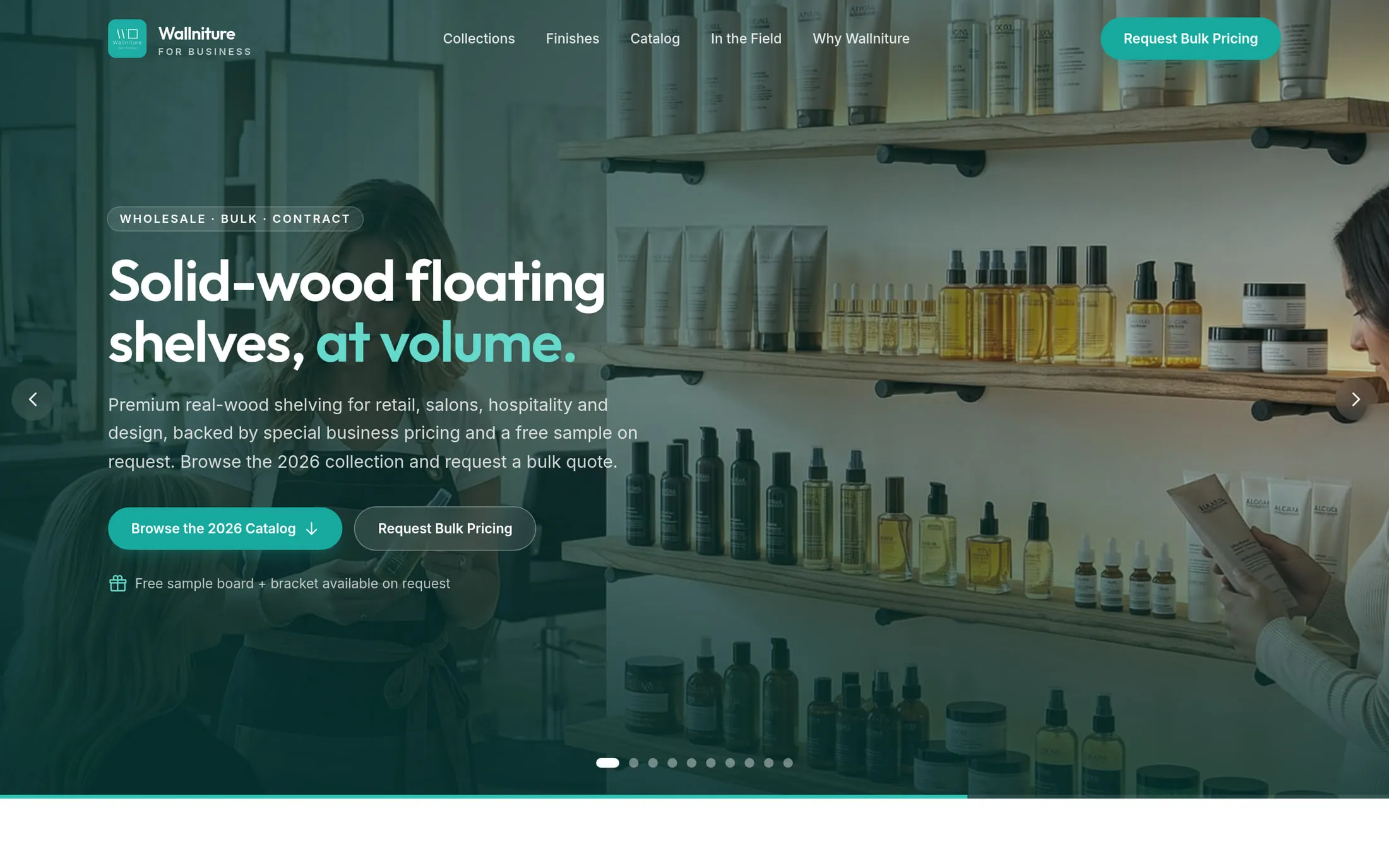
Wallniture for Business is a wholesale site for buyers who order solid-wood shelving by the pallet. It presents ten shelf profiles and seven hand-applied finishes as a browsable specification catalogue, with dimensions and load ratings on every product, a downloadable PDF catalogue, and a bulk pricing request flow that replaced quoting back and forth by email.
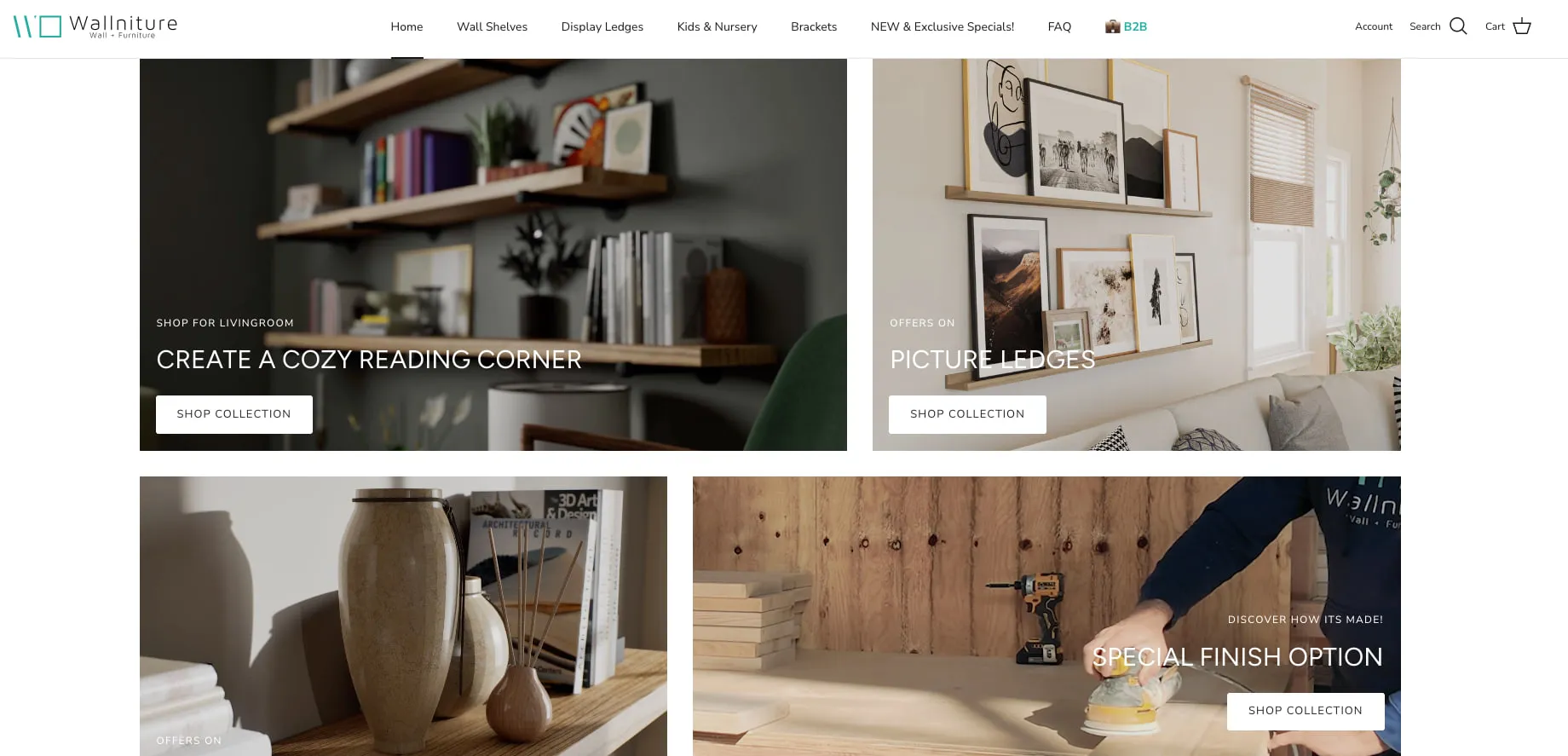
It sits beside the brand’s Shopify retail store, which hands wholesale buyers across from the same navigation. Retail shoppers get a checkout; trade buyers get a catalogue and a quote. Keeping the two apart meant neither had to be compromised to suit the other.
What a wholesale portal usually needs
Most trade portals are assembled from the same short list, and the work is in deciding which parts of it you actually need. Account approval, so only verified trade customers see trade prices. Customer or tier pricing, so a distributor and a single-shop retailer are not quoted the same. Minimum order quantities and case packs. Quick ordering by SKU or CSV upload, for buyers who already know what they want. Payment terms, and a quote request for orders too large or too custom to price automatically. And a downloadable catalogue for buyers who still work from paper.
One catalogue, maintained once
The cost of a wholesale channel is rarely the build. It is keeping two catalogues in step: a new finish added to the retail store and forgotten on the trade site, or a price changed in one place and not the other. Where the portal runs on Shopify, products, stock and prices come from the same admin. Where it is custom, we connect it to the store or the system that already holds your products, so the catalogue is maintained in one place.
From a studio that also makes the imagery
We came to wholesale through furniture. Wallniture’s portal sits on top of a decade of imagery we produced for the same range, and that matters more than it sounds: a trade catalogue only works when the images, the specification data and the finish swatches agree with each other. We produce the furniture renders as well as the site that shows them, so they are built to agree from the start.
Capabilities
What this covers.
- Trade account approval and login
- Customer and tier pricing
- Minimum order quantities and case packs
- Quick order by SKU or CSV
- Bulk quote request flows
- Specification catalogues and PDF downloads
- Shopify B2B setup and configuration
Deliverables
What you receive.
- 01Working portal, deployed on your domain
- 02Source code and repository access on custom builds
- 03Admin handover and documentation
- 04Support window after launch
Getting started
What to send us.
How you sell to trade today
Price lists, order forms, and the email thread a typical order goes through. The portal should replace that process, so we start from it.
Your pricing rules
Tiers, customer-specific prices, minimums, case packs and payment terms. These decide whether Shopify’s own B2B features are enough.
Your catalogue data
A product export from your store or ERP, with the fields trade buyers ask about: dimensions, materials, load ratings, finishes.
Where orders need to land
Your store, your accounting software or your warehouse system, so the portal hands orders to it rather than to an inbox.
Process
How it works.
- 01
Choose the route
We map your pricing rules against Shopify B2B, the main wholesale apps and a custom build, and recommend one in writing, with the reasons.
- 02
Scope and quote
A fixed scope and price for the route chosen, agreed before any work starts.
- 03
Build
Catalogue, pricing and ordering first, on a staging site you can test with a real trade customer.
- 04
Launch
Deployed on your domain, with your team shown how to add products, approve accounts and change prices.
- 05
Support
A support window after launch, with source code and repository access on custom builds.
Questions
Common questions.
Still unsure about something? Email us and a real person replies, usually the same day.
Do I need Shopify Plus for B2B?
Not for most of it any more. Since April 2026, Shopify’s Basic, Grow and Advanced plans include company profiles, payment terms, volume pricing and up to three B2B catalogues. Plus is still needed for unlimited catalogues, for assigning catalogues directly to companies, and for deposits or partial payments. If your trade pricing fits in three price lists, you may not need Plus at all.
How much does a B2B wholesale portal cost?
It is quoted against your requirements, because the range is wide. Configuring Shopify’s own B2B features on an existing store is a small job. A custom portal with its own catalogue, pricing logic and integrations is a software project. We recommend the cheapest route that does what you need before quoting it.
Can the portal sit beside our existing retail store?
Yes, and that is how Wallniture runs: a Shopify store for retail and a separate wholesale site for trade buyers, linked from the same navigation. On Shopify B2B the two can also share one store, with trade customers seeing their own prices once they log in.
Should wholesale buyers check out or request a quote?
It depends on how predictable your trade orders are. If prices and quantities are fixed, a checkout with payment terms saves everyone time. If orders are large, mixed or customised, a quote request that collects the whole order in one form usually works better than a checkout that cannot price it. Wallniture’s portal uses a quote request for that reason.
How long does a wholesale portal take to build?
Configuring Shopify B2B on a store that already exists is the quickest route. A custom portal depends on the size of the catalogue and the systems it connects to. Either way, you get a delivery date in writing with the quote.


Let's get your product
ready to launch.
Send us your CAD files, a sketch, or just a description of what you are building, and tell us how far you need it taken. We come back with a fixed quote and a date.